
Blog & news

Blog — Data Recovery and Cybersecurity

Technical analyses, prevention tips and data recovery news from the experts at SOS Data Recovery, Swiss laboratory since 2006.

Cybersecurity & prevention
In-depth technical analyses
Expert practical advice
Free diagnosis Estimate your recovery
Free diagnosis Quote within 3 hours Your data stays in Switzerland

Why read our data recovery blog?

The SOS Data Recovery blog covers all topics related to data recovery, cybersecurity and the protection of digital storage media. Our experts share in-depth technical analyses, prevention tips and insights from over 20 years of laboratory experience.

Whether you are an individual looking to protect your photos and documents, or an IT professional managing RAID servers and NAS systems, you will find practical, verified information here. SOS Data Recovery is CyberSafe certified and CyberSafe partner and rated 4.8/5 on Avis Vérifiés (296 reviews).

Our articles : #SSD

Active filter : #SSD All articles
Recovering Data from a Mac: Soldered SSD, T2 Chip and FileVault

Recovering Data from a Mac: Soldered SSD, T2 Chip and FileVault

On a recent Mac, the SSD is no longer a part you remove to read the data elsewhere: it is soldered to the logic board, and its contents are permanently encrypted by the chip, the T2 on Intel models and the Secure Enclave built into the processor on Apple Silicon M1 to M4. The decryption keys live inside this processor, and if it dies, they are lost, for everyone, Apple included. This guide explains why moving or desoldering the SSD achieves nothing, and why recovery goes through repairing the logic board to restore access to the keys. You will understand the real role of the T2 chip, the software layer FileVault adds, the Fusion Drive trap on older Macs, and above all what really remains recoverable. Two instincts follow: be wary of promises to recover everything, and back up with Time Machine and iCloud.

September 09, 2026 Author Stéphane Chapuis Read More
Lightning and Power Surges: the Electronics Die, but Your Data Often Survives

Lightning and Power Surges: the Electronics Die, but Your Data Often Survives

A lightning strike or a power surge does not destroy your data: it burns out the electronics that let you access it. On a hard drive, it is almost always the circuit board or the power supply that takes the hit, while the platters remain intact. In the vast majority of cases, replacing the board and transferring the ROM is enough to recover the content. This article explains where the voltage spike comes from (mishandling, distant lightning, flooding), what burns out depending on the device (hard drive, SSD, USB stick, server or NAS), and why the outlook often remains good. Two reflexes are essential: do not keep trying to power on a device that has suffered a surge, and be wary of any burnt smell. On the prevention side, a UPS protects critical hardware, a surge protector the rest, and a backup remains indispensable.

August 16, 2026 Author Stéphane Chapuis Read More
SSD: Why Data Recovery Has Nothing to Do With a Hard Drive

SSD: Why Data Recovery Has Nothing to Do With a Hard Drive

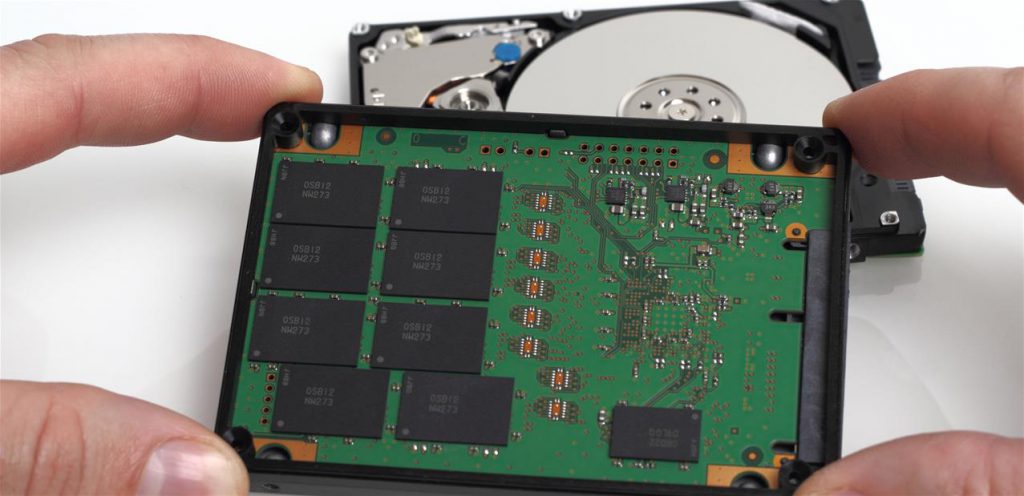
Recovering data from an SSD has almost nothing in common with a hard drive. There are no platters and no read/write heads here, but NAND memory chips driven by a controller, a bit like a USB stick, only far more complex. This difference in nature changes everything: the data is not stored where the system thinks it is, TRIM genuinely erases what you delete within minutes, and hardware encryption can lock everything away if the controller dies. This guide explains how an SSD is built, why recovering one is a trade of its own, and which failures come up most often: faulty controller, corrupted firmware, power surge, cold solder joint. You will also discover the puzzle of invisible BGA solder joints, what a lab really does (tools such as the PC-3000, firmware repair, desoldering and reading the chips), and above all the right moves: stop the device and never run a secure erase.

June 23, 2026 Author Stéphane Chapuis Read More
Intel Enters the SSD Market

Intel Enters the SSD Market

International manufacturer Intel finally unveils its first PCI-Express SSD, the SSD 910. Announced in 400 and 800 GB versions, which actually hide 448 GB and 896 GB of MLC-HET Flash - announced as more durable than classic MLC - this SSD hard drive uses a PCI-Express 2.0 x8 interface.

March 18, 2012 Author Stéphane Chapuis Read More
SanDisk Unveils New SSD Drives

SanDisk Unveils New SSD Drives

Manufacturer SanDisk, a global leader in flash memory cards, has announced the release of two new SSD hard drive models: the Extreme and the x100.

February 17, 2012 Author Stéphane Chapuis Read More
Available 24/7

Data emergency? We respond immediately.

In the event of critical data loss or a server failure, our on-call team responds urgently, including weekends and public holidays.